Have you ever finished a busy day at work, checked your bank account, and wished there were another source of income coming in without having to work extra hours every evening?
That is what makes passive income so appealing. Instead of relying entirely on a salary or exchanging every available hour for money, you build something that may continue generating revenue after the initial work is done.
But there is one important detail that many online articles leave out: passive income is rarely completely passive, especially at the beginning. A blog needs useful content, a rental property needs maintenance, and a digital product needs customers. Even investments require research and occasional attention.
The realistic goal is to put your time, skills, or money into something that can generate income repeatedly without requiring the same amount of work for every payment.
Some options require very little starting capital but considerable effort. Others need savings upfront but may require less day-to-day involvement. The right choice depends on your budget, experience, available time, and willingness to take risks.
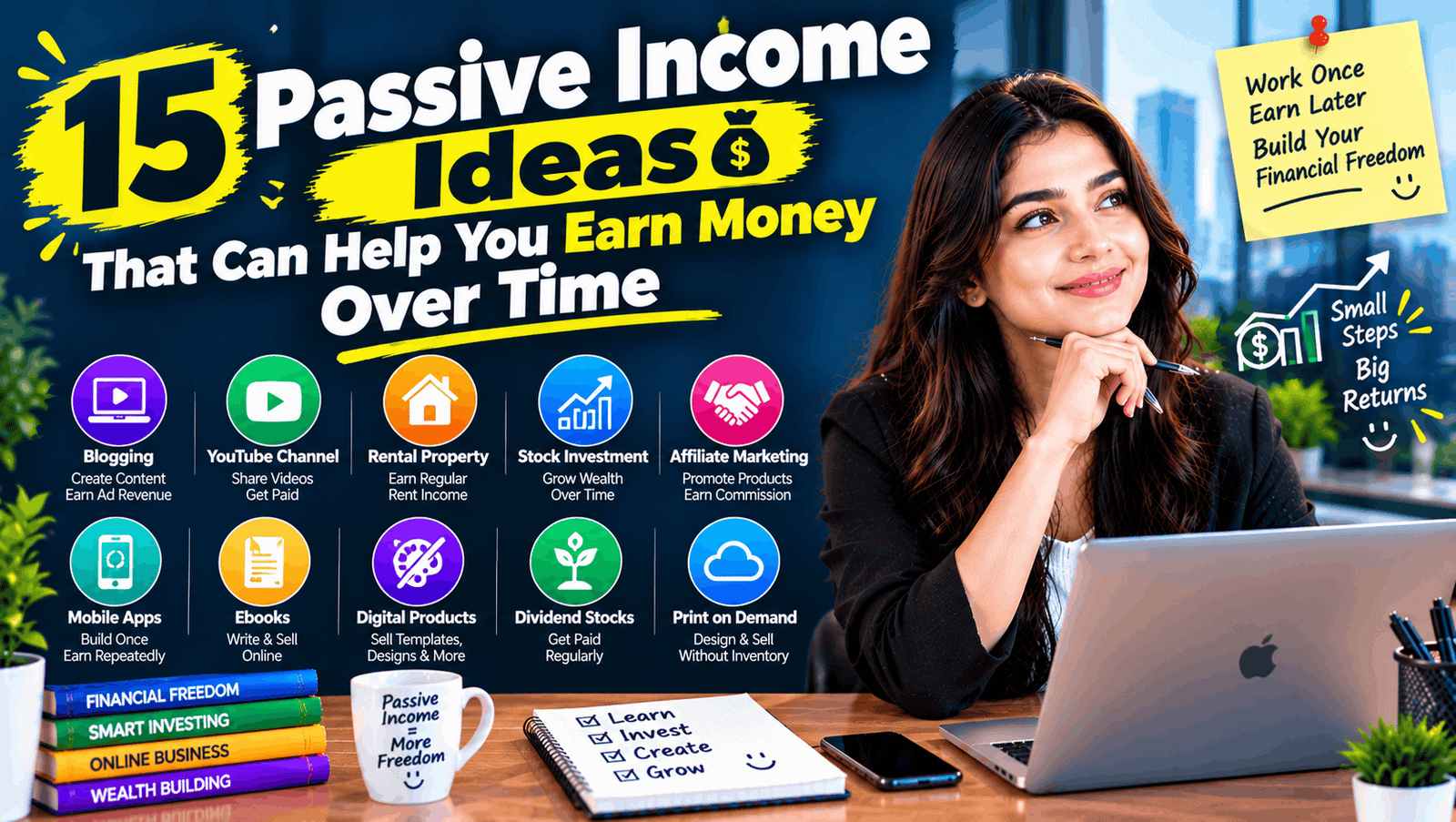
Here are 15 passive income ideas worth exploring, along with practical ways to get started, the challenges to expect, and common mistakes to avoid.
1. Start a Blog and Earn From Advertising

A blog can become a long-term income source when it attracts readers who find its content useful. You create articles once, and those articles may continue receiving visitors through search engines, social media, and other websites.
For example, imagine you publish a detailed guide explaining how to choose a laptop for college. If the article continues attracting relevant visitors months later, you may be able to earn advertising revenue from those visits.
Google AdSense is one option for displaying advertisements on eligible websites. Actual earnings depend on visitor location, advertiser demand, content category, ad placement, and other factors. Approval and revenue are never guaranteed.
How to get started
- Choose a subject you can cover accurately, such as technology, education, home improvement, or career guidance.
- Set up a website using a platform such as WordPress.
- Research the questions your target readers actually ask.
- Publish original articles that provide complete, practical answers.
- Improve your site’s speed, mobile experience, navigation, and readability.
- Apply for an appropriate advertising program when your website is ready and meets its requirements.
The biggest mistake is expecting a new website to generate substantial income immediately. Search traffic often takes time to develop, and some articles may attract very few visitors.
A better approach is to build a useful resource instead of publishing large quantities of repetitive articles simply to increase your page count.
2. Create and Sell Digital Products
Digital products are files or resources that customers can purchase and download online. Examples include budget spreadsheets, printable planners, study guides, website templates, original graphics, and e-books.
The attraction is straightforward: you create the product once and can potentially sell multiple copies without manufacturing a new physical item for each order.
Suppose you create a well-designed monthly budgeting spreadsheet. You can explain how it works, provide screenshots, and list it on a marketplace or your own website. If customers find it useful, the same product may generate additional sales over time.
Platforms such as Etsy and Gumroad offer ways to sell certain digital products, subject to their current rules and fees.
A practical starting plan:
- Identify a problem people repeatedly encounter.
- Create a simple product that solves that problem.
- Test it yourself and correct errors.
- Prepare clear previews and instructions.
- Set a reasonable price based on the product’s usefulness and comparable offerings.
- Promote it through relevant content or communities.
Digital products still require customer support, updates, and marketing. A product that is uploaded and never promoted may receive few or no sales.
Make sure you have the necessary rights to any fonts, images, templates, or other assets you include.
3. Invest in Dividend-Paying Stocks

Some publicly traded companies distribute part of their profits or available funds to shareholders through dividends. If you own eligible shares when a dividend is paid, you may receive a payment according to the company’s dividend policy.
This is one way investors can build an income-oriented portfolio, although it involves financial risk and requires money to invest.
For example, suppose an investment portfolio is worth $5,000 and produces an annual dividend yield of 3%. At that yield, the estimated annual dividend would be $150 before taxes and fees, assuming the yield and investment value remain unchanged.
That is an illustration, not a guaranteed return. Companies can reduce or cancel dividends, and the share price can fall by more than the dividends received.
Before investing, research the company’s financial health, payout history, debt, and ability to sustain its distributions. You can use resources such as Yahoo Finance and official company reports to begin your research.
Avoid buying a stock simply because it advertises a high dividend yield. A high yield can sometimes reflect a falling share price or concerns about the company’s financial position.
Dividend investing may suit people with a longer investment horizon, but it is not a substitute for an emergency fund or money needed for near-term expenses.
4. Consider Broad-Market Index Funds and ETFs
An exchange-traded fund (ETF) can hold many investments in one product. Some ETFs track broad market indexes, while others focus on specific industries, regions, bonds, or investment strategies.
For beginners who want to explore long-term investing, diversified funds can provide exposure to multiple companies without requiring them to research every individual stock.
Depending on the fund, returns may come from increases in the value of its holdings, distributions, or both. Some funds reinvest income rather than paying it directly to investors.
However, diversified funds are not risk-free. Stock funds can decline during market downturns, and specialized funds may be concentrated in a narrow part of the market.
Before purchasing a fund, review its investment objective, holdings, fees, risks, and distribution policy. Consider whether its strategy fits your financial goals and the length of time you can leave the money invested.
This approach is generally more appropriate for people who can tolerate market fluctuations than for someone who needs the money next month.
5. Create a YouTube Channel With Evergreen Content

YouTube content can sometimes continue attracting views long after the original video is published. This makes evergreen videos worth considering if you enjoy teaching, explaining technology, or solving common problems.
Evergreen topics remain useful over time. Examples include tutorials on spreadsheet formulas, basic computer troubleshooting, website setup, or choosing the right device for a particular task.
A video explaining how to back up photos from a phone may remain relevant for months or years, although it may need updating when software changes.
A realistic way to begin
Choose one subject and create a small collection of useful videos. Use a smartphone, a simple microphone, and free or affordable editing software if that is what your budget allows.
Focus on clear explanations, accurate demonstrations, and titles that describe what viewers will learn.
You may eventually qualify for YouTube monetization features, depending on the current eligibility requirements and your channel’s performance. Other potential income sources include sponsorships, affiliate links, and your own products.
The catch is that making videos requires planning, recording, editing, and promotion. Some videos never attract significant views, and advertising revenue is not guaranteed.
The long-term opportunity comes from building a library of useful content rather than expecting one viral video to provide permanent income.
6. Earn Rental Income From Property
Owning a rental property can produce recurring income when tenants pay rent, but it requires capital, careful planning, and ongoing responsibility.
Before purchasing a property, calculate the likely income and expenses. Mortgage payments, insurance, property taxes, repairs, vacancies, management fees, and local legal requirements can substantially affect the result.
For instance, a property collecting $1,500 in monthly rent does not necessarily generate $1,500 in profit. After expenses, the amount left over could be considerably lower, and unexpected repairs may reduce it further.
You may choose to manage the property yourself or hire a professional property manager. Management can reduce your workload, but it adds a cost and does not remove your legal responsibilities as the owner.
If you are interested in property income but cannot afford to buy a property, you could research publicly traded real estate investment trusts (REITs). These allow investors to gain exposure to real estate businesses through securities, but their prices can fluctuate and their distributions are not guaranteed.
Property-related investments should be evaluated carefully rather than treated as effortless or risk-free income.
7. Sell Stock Photography, Videos, or Original Graphics
If you enjoy photography, illustration, or video production, you may be able to license your work through stock-content marketplaces.
Businesses, publishers, designers, and content creators need original visuals for websites, presentations, advertisements, and other projects.
For example, you could photograph everyday office equipment, record original footage of a city, or create useful illustrations for educational content.
Platforms such as Adobe Stock provide opportunities for eligible contributors to license certain types of creative work under their terms.
The process usually involves producing high-quality original content, following technical and licensing requirements, submitting files for review, and organizing your portfolio.
A large portfolio does not automatically produce meaningful revenue. Some images may rarely sell, while others may find a more consistent audience.
Pay attention to copyright, model releases, property releases, and restrictions on recognizable brands or private locations. Only upload content you have the right to license.
8. Write an E-Book or Practical Guide
An e-book can turn knowledge you already have into a product that customers can purchase repeatedly.
You do not need to write a massive book. A focused guide that solves a specific problem may be more useful than a long publication filled with general information.
Examples include a beginner’s guide to using spreadsheets, a practical study planner, or an introductory manual for setting up a personal website.
Start by identifying a clear audience and the problem your guide will solve. Outline the chapters, research factual claims, include original examples, and edit the final manuscript carefully.
You can explore self-publishing services such as Amazon Kindle Direct Publishing or sell a downloadable PDF through an appropriate storefront.
Remember that publishing is only one part of the process. You still need a way to reach potential readers, explain the book’s value, and maintain accurate information.
If your guide covers finance, health, law, or another sensitive subject, research carefully and avoid presenting general information as personalized professional advice.
9. Build an Affiliate Marketing Website
Affiliate marketing involves recommending products or services through tracked links. If someone makes a qualifying purchase through your link, you may receive a commission under the program’s rules.
For example, a technology website might publish a detailed comparison of laptop accessories, explain the advantages and disadvantages of each option, and link to products from participating merchants.
A good affiliate article should help readers decide whether a product is suitable for them. It should not simply repeat manufacturer descriptions or claim that every product is the best.
To begin:
- Choose a subject you understand.
- Research relevant affiliate programs and their terms.
- Create honest reviews, comparisons, and tutorials.
- Clearly disclose affiliate relationships.
- Track clicks and qualifying conversions.
- Update information when products, prices, or program terms change.
Affiliate revenue depends on actual customer behavior, commission rates, and the quality of your traffic. Some programs also change their terms or discontinue products.
For website owners, the important lesson is to build trust first. Promoting unsuitable products for a quick commission can damage your reputation and reduce the value of your content.
10. License Music, Sound Effects, or Audio Loops
If you create music or work with audio, you can explore licensing original tracks, sound effects, and loops for use in videos, podcasts, games, or other projects.
For example, a video editor may need background music that fits a tutorial, while a game developer might need footsteps, notification sounds, or ambient effects.
You could create a collection of original audio assets and offer them through suitable marketplaces or licensing services.
The work involves more than uploading files. You need to produce clean recordings, organize files properly, understand licensing terms, and make sure you have the rights to every sound you use.
Never assume that a sound downloaded from the internet is free to resell or redistribute. Read the license carefully and keep records of the permissions associated with your work.
11. Create an Online Course
An online course can be useful if you have a skill that other people want to learn.
Possible subjects include basic computer skills, video editing, website development, photography, language learning, or spreadsheet techniques.
Start with one specific learning outcome. For instance, rather than creating a course called “Everything About Technology,” you could teach beginners how to build a simple WordPress website.
Record short lessons, provide exercises, and include practical demonstrations. You can host a course through a suitable educational platform or sell access through your own website.
The initial workload can be significant. You may need to prepare lessons, record demonstrations, answer student questions, and update outdated material.
A course is more likely to provide lasting value when it helps students achieve a clear result rather than simply offering a large number of videos.
12. Sell Website Themes, Plugins, or Templates
If you have web development or design skills, you can build reusable digital tools for other website owners.
Examples include WordPress block patterns, website templates, original icons, business landing-page designs, and plugins that solve specific problems.
The advantage is that the same product can serve multiple customers. However, the work does not end after the first release.
Software may need security updates, compatibility fixes, documentation, and customer support. Poorly maintained products can create problems for the people who use them.
If you are just learning to code, begin with a small project that does one thing well. Test it thoroughly before selling it, explain its limitations, and provide a clear way for customers to report problems.
13. Rent Out Equipment You Already Own
Depending on local demand and applicable rules, equipment you already own may be suitable for rental.
Examples include photography gear, specialist tools, camping equipment, or event supplies.
This approach can be worth exploring if the equipment would otherwise sit unused for long periods.
Before offering anything for rent, calculate cleaning, maintenance, transportation, platform fees, and potential replacement costs. Check whether your insurance covers rental activity and what happens if an item is damaged or returned late.
A written agreement, clear condition records, and an appropriate deposit or protection arrangement can help reduce disputes.
Rental income is not completely passive because someone still needs to coordinate bookings, handovers, inspections, and maintenance. It may work best when the item is in demand and the process can be managed efficiently.
14. Earn Interest on Eligible Savings
Savings accounts and other interest-bearing cash products can provide income without requiring you to manage individual stocks or operate a business.
Depending on your country and financial institution, options may include high-interest savings accounts, term deposits, or certificates of deposit.
For example, if an eligible account pays 4% annual interest on a constant balance of $5,000, the approximate interest over a year would be $200 before taxes, assuming the rate remains unchanged and ignoring compounding.
That example is not a promise that any particular account will pay 4%. Rates, eligibility, withdrawal restrictions, and fees vary.
Before opening an account, check the institution’s regulatory status and whether deposit protection applies. In the United States, eligible deposits at FDIC-insured banks are generally insured within applicable limits and ownership categories. Investment products such as stocks and mutual funds are not FDIC-insured simply because they are purchased through a bank.
This option may suit people who prioritize access to their savings and lower risk over the possibility of higher but more uncertain investment returns.
15. Build a Print-on-Demand Store
Print-on-demand allows you to sell designs on products such as T-shirts, mugs, posters, or tote bags without personally keeping large amounts of inventory.
When a customer places an order, a production partner prints the design and handles fulfillment under the arrangement you choose.
You might create designs for a specific hobby, profession, or interest group. The challenge is finding a design and audience that stand out among many competing products.
Before launching, check production costs, shipping times, refund policies, platform fees, and your expected profit per sale.
For example, if a product sells for $25 but production, fulfillment, platform fees, and other costs total $19, the remaining $6 is the amount before any additional expenses or applicable taxes.
Avoid using copyrighted characters, company logos, celebrity images, or slogans you do not have permission to use. A design that receives attention is not worth the legal or financial risk of infringing someone else’s rights.
Print-on-demand reduces some inventory risks, but marketing, customer service, and product quality still require attention.
Which Passive Income Idea Should You Choose?
The best option depends on what you already have: time, skills, savings, or an audience.
| Your situation | Options worth researching |
|---|---|
| Little starting money, but time to learn | Blogging, digital products, affiliate marketing |
| Comfortable creating videos | YouTube, stock footage, online courses |
| Have money available for investing | Diversified funds, dividend stocks, eligible savings accounts |
| Own useful equipment or property | Equipment rental, property rental |
| Have design or technical skills | Website templates, print-on-demand, stock graphics |
| Prefer simpler financial products | Interest-bearing savings accounts |
These are starting points, not guaranteed recommendations. Each option has different risks, costs, and eligibility requirements.
A Practical 30-Day Plan for Building Your First Income Source
You do not need to launch five projects at once. Choose one idea and use the first month to find out whether it fits your situation.
Your first-month checklist
0 of 4
Week 1: Choose one idea
Set a budget, define your goal, and research the main costs and risks.
Week 2: Create the foundation
Build your first article, product, portfolio, or investment plan.
Week 3: Test demand
Publish useful content, reach potential customers, or compare suitable financial products.
Week 4: Review the evidence
Track costs, interest, sales, traffic, or other relevant results and decide what to improve.
A month may be enough to test an idea, but it may not be enough to generate meaningful income. Blogging, online courses, and digital products often need longer to find customers. Investment returns also vary and may be negative.
Focus on learning what works rather than chasing a deadline.
Common Passive Income Mistakes to Avoid
1. Expecting money without initial work. Most income sources require some combination of setup, research, maintenance, or customer service.
2. Spending too much before testing demand. Avoid paying for expensive software, courses, inventory, or equipment before you understand whether people want what you plan to offer.
3. Believing guaranteed-return claims. Be skeptical of anyone promising fixed high returns from a supposedly risk-free opportunity. Check the details independently before transferring money.
4. Ignoring ongoing costs. Hosting, advertising, platform fees, repairs, taxes, and payment processing can reduce your actual profit.
5. Depending on only one source forever. Once an income source becomes established, you can consider whether another source would suit your goals. However, spreading yourself across too many projects too early can slow progress.
6. Forgetting that rules matter. Follow relevant tax, copyright, consumer protection, advertising disclosure, and platform requirements. If you are earning across borders, check which country’s rules apply to you.
Final Thoughts
Passive income can help you build additional financial flexibility, but it is better viewed as a process than a shortcut.
A blog may take months to attract a consistent audience. A digital product may need several revisions before customers find it useful. Investments may fluctuate for years, and rental businesses can face unexpected expenses.
The encouraging part is that you do not have to begin with a large budget or an elaborate business plan. You can start by identifying a useful skill, creating something that solves a real problem, or learning how suitable financial products work.
Choose one approach that matches your circumstances, test it carefully, and measure the results. When you understand the costs, workload, and realistic income potential, you can make a better decision about whether to continue, improve, or try something different.
The real goal is not to find money that requires absolutely no effort. It is to build an income source where today’s work, savings, or investment can continue providing value in the future.